A microservices architecture is an architectural style that structures an application as a collection of small, autonomous, and loosely coupled services. Each service is self-contained, organized around a specific business capability, and can be developed, deployed, and scaled independently. This approach contrasts with the traditional monolithic architecture, where the entire application is built as a single, indivisible unit.
The choice depends on the project's context. A monolith is often a good starting point, while microservices are better suited for mature, complex applications.
Conway's Law states: "Any organization that designs a system will produce a design whose structure is a copy of the organization's communication structure." Microservices architectures align well with this law. By structuring teams around business capabilities (e.g., a "Payments Team" owning the "Payment Service"), you empower them to build, deploy, and maintain their service autonomously. This reduces cross-team communication overhead and improves agility, which is a core goal of microservices.
There is no fixed rule. A microservice should be "small enough to be managed by a single team, but large enough to provide a meaningful business capability." Key principles are:
A Bounded Context is a central concept in DDD that defines the boundaries of a specific business domain. Within a bounded context, a particular domain model (e.g., the meaning of "Customer") is well-defined and consistent. Microservices should be designed around these bounded contexts to ensure they have clear responsibilities and are loosely coupled.
Loose coupling is a design principle where components (services) are designed to have minimal knowledge of and dependency on each other. In microservices, this is achieved through well-defined, stable APIs and asynchronous communication. It allows a service to be changed or replaced without impacting the services that consume it.
High cohesion means that all the elements within a single service are closely related and focused on a single, well-defined purpose. For example, a "User Management" service should handle everything related to users (creation, authentication, profile updates) but should not handle payment processing.
You should avoid microservices for small, simple applications, proofs of concept, or when your team lacks the necessary DevOps and distributed systems expertise. The operational complexity and initial development overhead can outweigh the benefits for such projects.
A distributed monolith is an anti-pattern where an application is built as a set of distributed services, but they are so tightly coupled (e.g., through synchronous calls, shared databases, or breaking changes) that they cannot be deployed or scaled independently. It combines the complexity of a distributed system with the inflexibility of a monolith.
Many of these principles are also reflected in broader system design patterns. You can read more about them in our post on the top 15 system design patterns.
The decision should be driven by business needs, not just technical trends. Key triggers include:
Containers, like Docker, provide a lightweight, portable, and consistent environment for microservices. They encapsulate the service and its dependencies, ensuring it runs the same way in development, testing, and production.
REST is an architectural style for designing networked applications. It's based on a stateless, client-server communication protocol, almost always HTTP. It uses standard HTTP methods (GET, POST, PUT, DELETE) to operate on resources identified by URIs. It's the most common style for synchronous communication in microservices.
gRPC (Google Remote Procedure Call) is a modern, high-performance RPC framework that is well-suited for service-to-service communication. Key features and differences from REST:
.proto file, which can be used to generate client and server code in multiple languages.For a practical guide on implementing gRPC with Java and Spring Boot, check out our blog post on gRPC with Java and Spring Boot.
A message broker is an intermediary software that enables services to communicate with each other asynchronously. Producers send messages to the broker, which then delivers them to the interested consumers. Examples include RabbitMQ and Apache Kafka.
| Feature | RabbitMQ | Apache Kafka |
|---|---|---|
| Architecture | A smart broker that delivers messages to consumers. | A dumb broker that stores a persistent log of messages (events). |
| Paradigm | Primarily used for message queuing. | Primarily used for event streaming. |
| Message Consumption | Messages are removed from the queue once consumed. | Messages are persisted in a log and can be re-read multiple times by different consumers. |
| Use Case | Traditional messaging, task queues. | Real-time data pipelines, event sourcing, streaming analytics. |
An event-driven architecture is a model where services communicate by producing and consuming events. An event is a notification that represents a significant change in state (e.g., OrderPlaced, PaymentProcessed). This promotes loose coupling and scalability, as services can react to events without having direct knowledge of the services that produced them.
An idempotent operation is one that can be performed multiple times without changing the result beyond the initial execution. This is crucial in distributed systems where network issues can cause clients to retry requests. Without idempotency, a retry could lead to duplicate actions, such as charging a customer twice.
PlaceOrderCommand).OrderPlacedEvent).The Circuit Breaker pattern is used to detect failures and prevents the application from trying to perform an action that is doomed to fail. This is essential for building resilient microservices that can handle partial failures gracefully. The circuit breaker acts as a proxy for operations that might fail. It monitors for failures and, after a certain threshold is reached, it "trips" and all further calls to the circuit breaker return with an error, without the protected operation being attempted at all.
Use Cases:
This diagram illustrates the three main states of a circuit breaker:
Related Read:
For a deep dive into building robust, failure-resistant microservices in Spring Boot, check out Resilient Microservices Patterns.
A fallback is the action taken when a circuit breaker is open or a request fails. It provides a default response to the client instead of an error. This could be a static response, data from a cache, or a call to another, simpler service.
The Bulkhead pattern is a resilience pattern that isolates elements of an application into pools so that if one fails, the others will continue to function. For example, you can have separate thread pools for connections to different microservices. If one service becomes slow and saturates its thread pool, it won't affect the threads available for other services.
To learn more about building resilient systems, read our posts on resilient microservices and the retry pattern in Spring.
This pattern is used for incrementally migrating a legacy monolithic application to microservices. You create a facade that intercepts requests to the monolith. Over time, you build new functionality as microservices and update the facade to route requests to the new services. Eventually, the monolith is "strangled" and can be decommissioned.
The Saga pattern is a design pattern for managing data consistency across microservices in a distributed transaction. Since a traditional two-phase commit (2PC) is often not suitable for microservices due to its synchronous and blocking nature, the Saga pattern provides an alternative.
A saga is a sequence of local transactions. Each local transaction updates the database in a single service and then publishes an event or message to trigger the next local transaction in the saga. If a local transaction fails for some reason, the saga executes a series of compensating transactions to undo the changes that were made by the preceding local transactions.

CQRS (Command Query Responsibility Segregation) is a pattern that separates read and write operations.
This is a core principle of microservices. Each microservice should own its own data and be solely responsible for it. Direct access to a service's database by other services is strictly forbidden. Communication must happen through the service's API. This ensures loose coupling.
The CAP Theorem states that in a distributed data store, it is impossible to simultaneously provide more than two out of the following three guarantees:
Eventual consistency is a model that guarantees that, if no new updates are made to a given data item, all accesses to that item will eventually return the last updated value. It's a trade-off made to achieve high availability and is common in systems that use asynchronous communication.
Event sourcing is a pattern where state changes are stored as an immutable sequence of events. Instead of storing the current state of an entity, you store the history of events that have affected it. The current state can be reconstructed at any time by replaying the events.
For a deep dive into event sourcing, check out our article on event sourcing explained.
Sharing a database between services creates tight coupling. If the schema is changed for one service, it can break other services. It also prevents services from being deployed and scaled independently, violating the principle of autonomy.
An API Gateway is a server that acts as a single entry point for all client requests to the backend microservices. It simplifies the client-side implementation by providing a unified interface, regardless of how the backend services are structured.
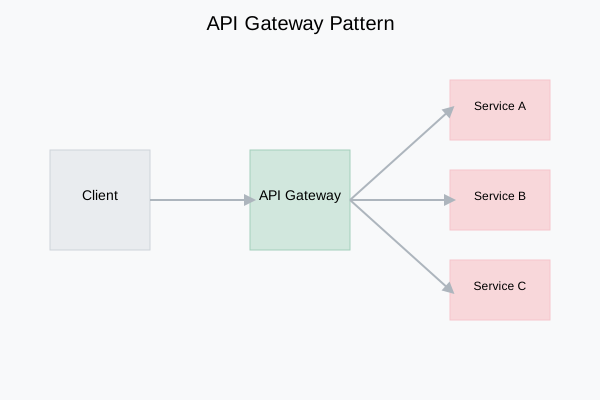
Key responsibilities of an API Gateway include:
In a microservices architecture, service instances have dynamic network locations. Service Discovery is the process of figuring out the current address of a service instance. The two main patterns are:
A Service Registry is a database containing the network locations of available service instances. It is a critical part of service discovery. Service instances register themselves with the registry when they start up and de-register when they shut down.
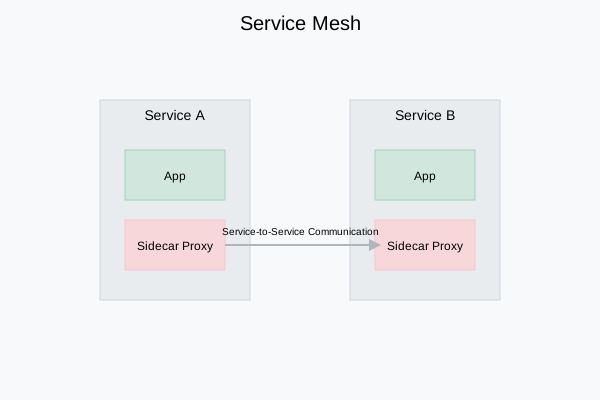
A service mesh (e.g., Istio, Linkerd) is a dedicated infrastructure layer for making service-to-service communication safe, fast, and reliable. It provides features like service discovery, load balancing, encryption, and observability, typically by deploying a sidecar proxy next to each service instance.
A canary release is a deployment strategy where you release a new version of a service to a small subset of users. You then monitor its performance and error rates. If it performs well, you gradually roll it out to the rest of the users. If it has issues, you can quickly roll it back with minimal impact.
This is a release strategy where you have two identical production environments: "Blue" (the current version) and "Green" (the new version). You deploy the new version to the Green environment, and once it's verified, you switch the router to direct all traffic to Green. This allows for a near-zero downtime release and a quick rollback.
Kubernetes is a container orchestration platform that automates the deployment, scaling, and management of containerized applications. It handles tasks like load balancing, self-healing, and service discovery, making it a powerful tool for managing microservices.
Configuration should be externalized from the application code. A common pattern is to use a centralized configuration server. Services query this server at startup to fetch their configuration. Tools like Spring Cloud Config, HashiCorp Consul, and Kubernetes ConfigMaps are used for this.
JWT is an open standard for securely transmitting information between parties as a JSON object. It is commonly used for authentication and authorization. A JWT consists of three parts: a header, a payload (containing "claims" like the user ID), and a signature. The signature ensures that the token has not been tampered with.
📖 Further Reading: For a detailed beginner-friendly explanation of JWT, see JWT Explained for Beginners.
OAuth 2.0 is an authorization framework that allows a user to grant a third-party application limited access to their resources on another service, without exposing their credentials.
Service-to-service communication should also be secured. Common patterns include:
In a microservices architecture, logs are spread across many services. Centralized logging is the practice of aggregating all these logs into a single, central location so they can be easily searched, analyzed, and monitored. A common architecture for this is the ELK Stack (Elasticsearch, Logstash, Kibana).
Distributed tracing is a method to track a request's entire journey through a multi-service architecture. Each service adds contextual information (a "span") to a shared "trace" as it processes the request. This allows you to visualize the flow, identify which service is causing a bottleneck, and debug complex interactions. Tools like Jaeger and Zipkin are used for this.
A health check is an endpoint on a service (e.g., /health) that can be called by an external system (like a load balancer or Kubernetes) to check if the service is running and able to handle requests. This is crucial for automated systems to know whether to route traffic to an instance or to restart it.
Chaos Engineering is the discipline of experimenting on a distributed system to build confidence in its ability to withstand turbulent conditions in production. It involves deliberately injecting failures (e.g., shutting down a service, introducing network latency) in a controlled environment to identify weaknesses.
🔗 Blog: https://codewiz.info
🔗 LinkedIn: https://www.linkedin.com/in/code-wiz-740370302/
🔗 Medium: https://medium.com/@code.wizzard01
🔗 Github: https://github.com/CodeWizzard01
Find the most popular YouTube creators in tech categories like AI, Java, JavaScript, Python, .NET, and developer conferences. Perfect for learning, inspiration, and staying updated with the best tech content.

Get instant AI-powered summaries of YouTube videos and websites. Save time while enhancing your learning experience.
